
I was at the whiteboard with my two daughters, explaining what happens between writing a line of code and getting a computer to do something. We drew the layers from languages like Scratch and Python down to the instructions a processor can execute. Even asking AI along the way using voice to help explain it in more depth.
Then we added another layer at the top. With an AI assistant, you can describe what you want in everyday language and ask it to write the code.
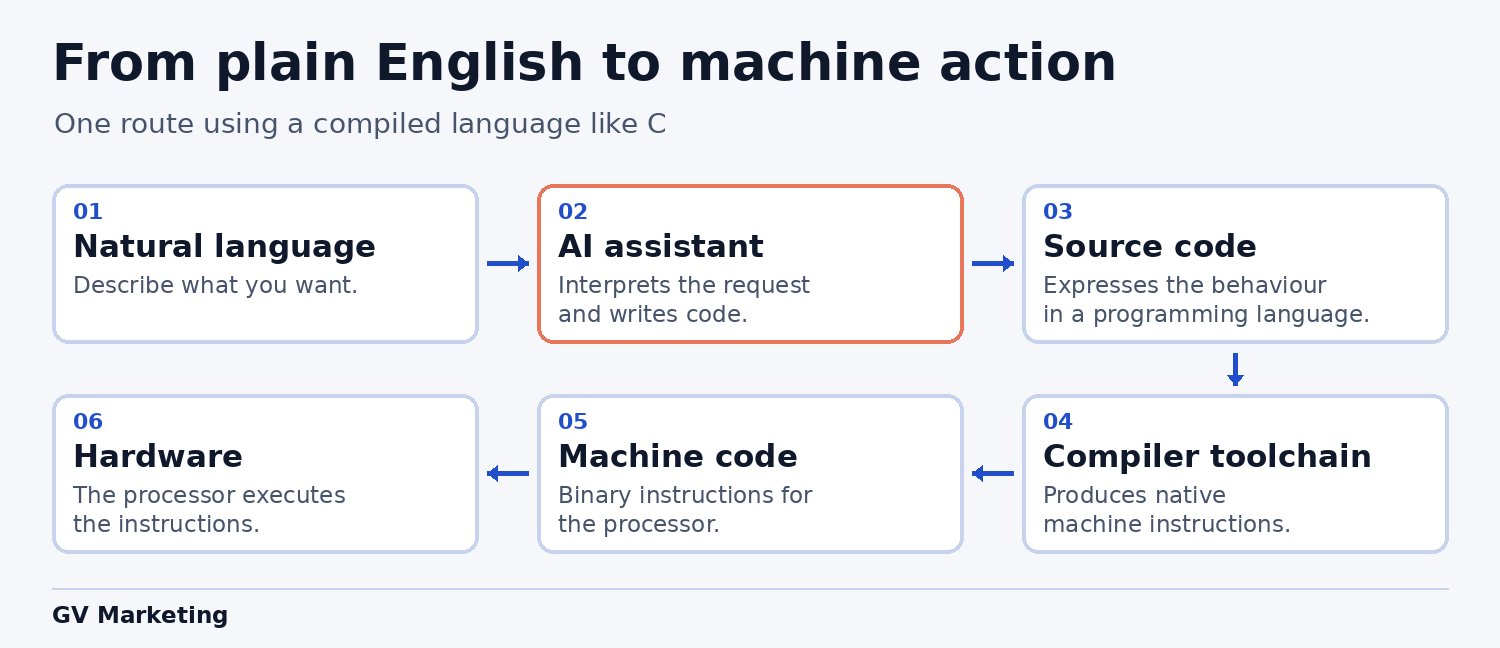
This diagram uses C as an example of how source code becomes native machine code. Python typically takes a different route. Its standard implementation compiles source code into bytecode, which the Python runtime executes.
That led to a question. If we can just say what we want, why did we need programming languages in the first place?
Part of the answer is that programming languages give instructions a precise meaning. Ask someone to “make the game harder” and they might speed up the enemies, give the player fewer lives or put the next checkpoint further away. An AI can pick one of those interpretations and write code for it. You’ll still need to play the game to see whether it made the game harder in the way you wanted.
I hear a version of the same instruction in marketing all the time. “Move budget out of the underperforming campaigns and into what’s working.”
What does ‘working’ mean?
Suppose you sell tickets for a visitor attraction. Your brand search campaign, which reaches people already searching for the attraction by name, reports bookings at £5 each. A campaign targeting people looking for things to do nearby comes in at £15. Ask an AI agent to favour the lowest cost per booking and it has a clear answer.
Now imagine you’re deciding where to put an extra £1,000. Some of the people searching for your attraction by name might have booked through your website anyway. The broader campaign might bring in families who hadn’t considered visiting. Or it might reach people who browse and rarely buy. The reported cost per booking leaves that question open.
Then there’s what each booking is worth. A discounted single ticket and a full-price family booking both count as one conversion in a basic report. Once you factor in refunds and the costs of serving those bookings, they may contribute very different amounts to the business.
So the same instruction could mean “buy more of the bookings we can get cheaply”, “buy bookings that leave us with more profit”, or “generate bookings we wouldn’t have got anyway”. Those are three different decisions. And even if one campaign did the best job last month, you still need to work out what it can deliver with the next £1,000.
What I’d ask the AI to do
I’d start with the commercial decision. “We have £1,000 to test where we can generate more contribution after media costs. Compare these two campaigns using booking data after refunds and variable costs. Show me what we know about how many of those bookings the ads actually caused. If the evidence is thin, propose a small test, with a spending limit and a clear rule for what would justify increasing it.”
That gives the AI something concrete to work with. It can reconcile booking data with ad spend, flag gaps and work through what would have to be true for each option to pay off. If all we have is a platform report, the result might be a decision about what to test before we commit more budget.
I spent years making these calls with millions in marketing investment. The question I kept coming back to was what would happen if we spent a little more here and a little less there. A dashboard could tell me where the last pound went and what the platform credited it with. Deciding where the next one should go meant asking what would change for the business.
That’s the work I do at GV Marketing. If you’re deciding where to put your next pound of marketing budget, get in touch. Bring the decision you’re weighing up and the numbers you’re using to make it.