Every channel's winning. Somehow, the business isn't. Paid search wants more budget, paid social has a convincing story and finance wants to know where the money went. You're the person who has to defend the next investment decision, with three versions of success and one bank account. Another dashboard won't necessarily settle it. You need to work out which evidence deserves your confidence and what you're prepared to do with it.
Start by putting the actual decision on the table. “Improve marketing efficiency” leaves plenty of room for competing interpretations. “Decide whether to move £20,000 of next month's budget from one activity to another, while protecting contribution and new customer acquisition” gives everyone a question they can investigate. It also exposes the cost of another month spent debating the numbers. Better measurement may be needed, but the business still has a decision to make. Give it an owner, a deadline and a clear account of what's at risk.
Agree what growth is worth paying for
Revenue is a starting point, although two sales of the same value can have very different economics. Margin, refunds, fulfilment costs and the likelihood of a customer returning can change what the business can afford to spend. In travel, a booking in one market or season may have different value from a booking elsewhere. In an app business, an inexpensive install can become costly if few users activate or stay. Treat those outcomes as equally valuable and you can get very efficient at buying the wrong customers.
I use Value, Volume and Rate to structure this diagnosis. What value is the business trying to create? What volume of customers, orders or bookings produces it? Which rates explain the movement, such as conversion or value per order? Define the relationship for the business in front of you. For example, revenue equals orders multiplied by average order value, while orders can be decomposed into sessions multiplied by conversion rate. Keeping the relationships explicit helps avoid counting the same improvement twice.
Check whether you're even arguing about the same thing
Attribution reports allocate credit using their own rules and available observations. A platform might count a sale after an ad interaction even when another platform also claims it. Different attribution windows, conversion dates, customer definitions and revenue treatments can make apparently similar metrics describe different things. Before anyone wins the argument, check that they're talking about the same outcome over the same period. Otherwise, the meeting rewards confidence more than evidence.
Some discrepancies can be reconciled technically. Others reflect different questions. A platform's attributed revenue, a model's estimate of channel contribution and an experiment's measured lift aren't interchangeable numbers. Force them into one league table and the neatness comes at a price: the assumptions disappear just when you need to challenge them. Record what each source tells you, what it leaves uncertain and how that uncertainty affects the proposed decision.
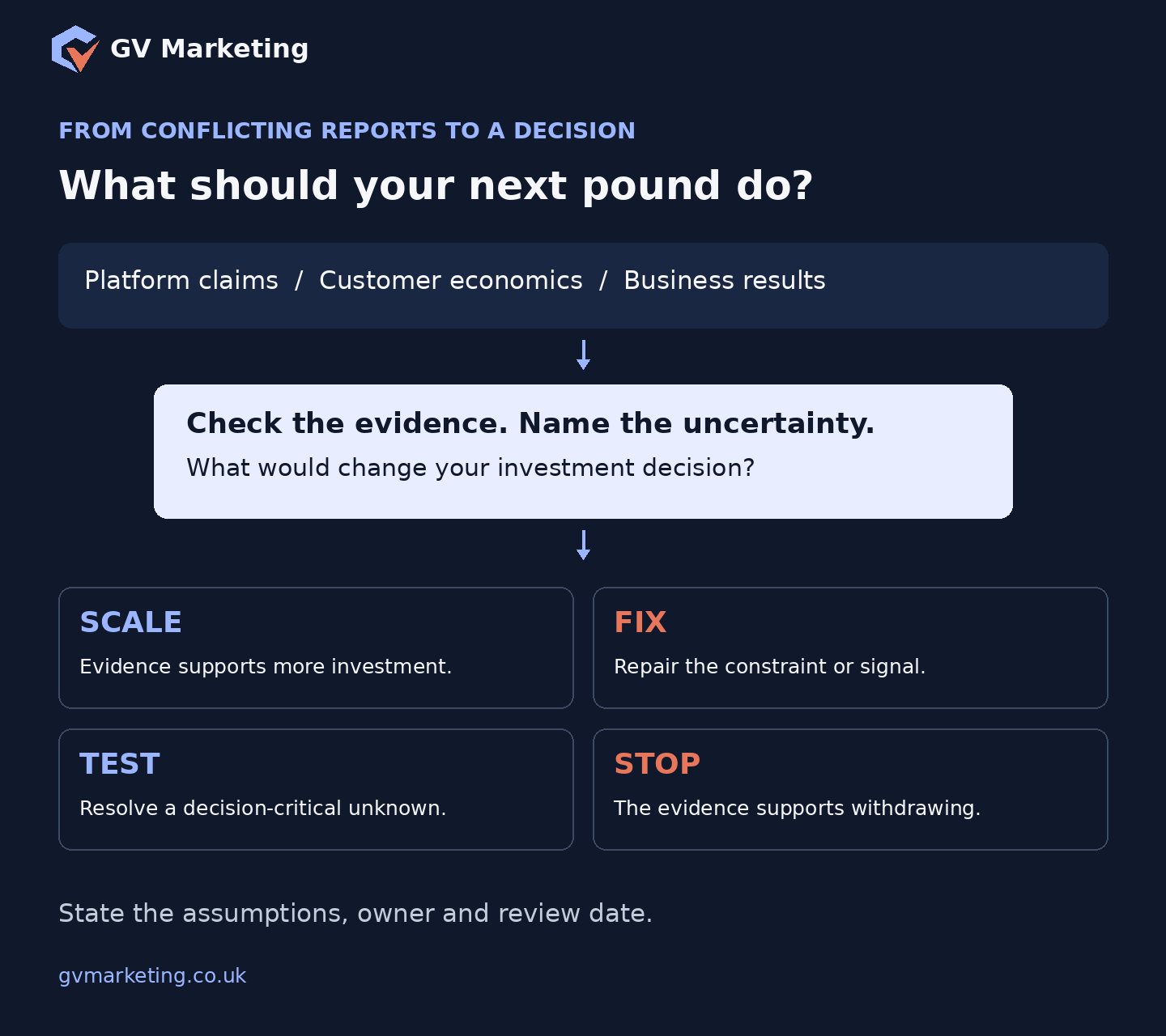
Give the uncertainty a job
Consider this illustrative situation. An established consumer business has £20,000 available to reallocate within its existing monthly budget. Brand search reports the highest ROAS. Paid social reports a lower return, but appears to reach more new customers. A recent tracking change makes the week-on-week comparison less reliable. These observations don't establish which activity creates the most incremental contribution, but they do identify different next steps.
| Activity or issue | Available evidence | What remains uncertain | Proportionate next action |
|---|---|---|---|
| Brand search | High reported ROAS and substantial existing-customer demand | How many sales would happen without the ads | Keep essential coverage while designing a feasible incrementality test |
| Paid social | Lower reported ROAS and a higher recorded new-customer share | Customer value and return at additional spend | Reconcile cohort economics before authorising expansion |
| Recent tracking change | Measurement definitions changed during the comparison | How much of the reported movement is a measurement break | Rebuild a comparable baseline before using the trend |
In this situation, I'd resist the pressure to announce a big reallocation just to end the debate. Holding the total budget, repairing the comparison and setting aside a defined amount for learning could be the responsible call. Stronger commercial evidence might justify moving money immediately. Either way, the recommendation needs a reason someone can examine. The best-presented chart shouldn't get automatic access to the budget.
Assess the next pound, then set a review
An average return describes performance across the investment already made. A reallocation decision concerns what's likely to happen when spend changes. The strongest historic average doesn't automatically identify the best destination for additional money, particularly when demand is limited or the activity is already heavily funded. Where credible response estimates are available, examine the relevant spend range and uncertainty. Where they aren't, a controlled, reversible change may be more useful than a confident extrapolation.
Write the recommendation in a form the leadership team can challenge: the amount to move or hold, the expected commercial consequence, the assumptions, the confidence level and the evidence that would change your view. Give someone responsibility for implementing it and agree when results will be reviewed. If the action is a test, define what can realistically be learned and whether the sample will be sufficient before spending the money. Reversibility can justify acting with less certainty, although it doesn't make a weak test informative.
When you're accountable for the budget, uncertainty can feel like a personal weakness. It isn't. Pretending the evidence is stronger than it is creates a much bigger problem. I'd rather see a leader explain a defensible decision, its limits and what would change their mind than present a precise answer nobody can properly challenge. That's the standard measurement should help you reach.
If you're stuck defending a budget that your reports can't explain, let's talk about the decision in front of you. GV Marketing helps growth leaders work through the evidence and decide what to scale, fix, test or stop. Discuss your investment decision.